

How to Get a 504 Plan for Your Child: A Step-by-Step Parent Guide
If you're trying to figure out how to get a 504 Plan for your child, you're in the right place.
This guide walks you through every step, from understanding what a 504 Plan is to requesting one in writing to knowing what to do if the school says no.
What is a 504 Plan?
A 504 Plan is a school support plan for a student with a disability who needs accommodations or supports to access learning.
504 Plans help remove school barriers. This is called equal access. 504s come from Section 504 of the Rehabilitation Act, a federal civil rights law that protects students with disabilities from discrimination.
In simple terms, a 504 Plan can change your child’s school environment so they can learn alongside their non-disabled peers.
A 504 Plan may include supports such as extra time, breaks, medical support, behavioral support, reduced-distraction testing, written directions, or access to the school nurse.
Unlike an IEP, a 504 Plan usually doesn't include special education goals or specialized instruction.
Federal law doesn’t require 504 Plans to be written, but many schools create written 504 Plans so everyone knows what supports and accommodations will be provided.
Who Qualifies for a 504 Plan?
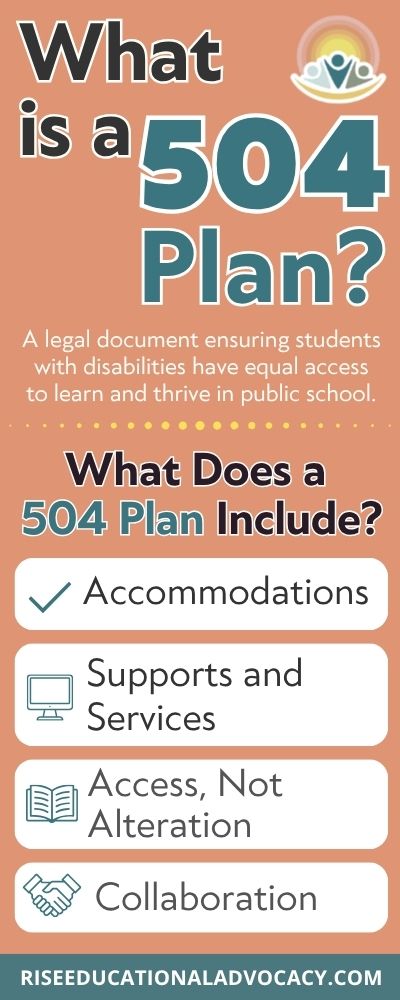 A child may qualify for a 504 Plan if they have a physical or mental impairment that substantially limits one or more major life activity.
Major life activities can include learning, reading, concentrating, thinking, communicating, walking, breathing, eating, sleeping, working, or major bodily functions.
Your child doesn’t have to fail to qualify for a 504 Plan.
Grades aren't the only factor. Some children get good grades but are still working much harder than their peers, missing school, needing medical care, or struggling to access the school day.
Your child may need a 504 Plan at school for ADHD, anxiety, autism, dyslexia, depression, diabetes, asthma, epilepsy, food allergies, chronic illness, mobility needs, medical needs, mental health needs, or executive functioning needs.
Two of the most common reasons parents request a 504 Plan are ADHD and anxiety. A 504 Plan for ADHD may include movement breaks, extended time, preferential seating, or planner checks to support focus and organization.
A 504 Plan for anxiety may include a safe person check-in, a break card, reduced-distraction testing, or a make-up work plan for days your child struggles to attend. If your child has either a diagnosis or is regarded as having one and it creates a barrier at school, a 504 Plan may be the right next step.
A medical diagnosis can help, but a diagnosis alone doesn't automatically qualify a child for a 504 Plan. The key question is:
Does your child’s impairment create a barrier to school access?
If yes, it may be time to ask about a 504 Plan.
How to Request a 504 Plan at School
To start the 504 process, put your request in writing.
Don’t ask only in a parent-teacher conference, at pickup, or during a school meeting. An official letter creates a record.
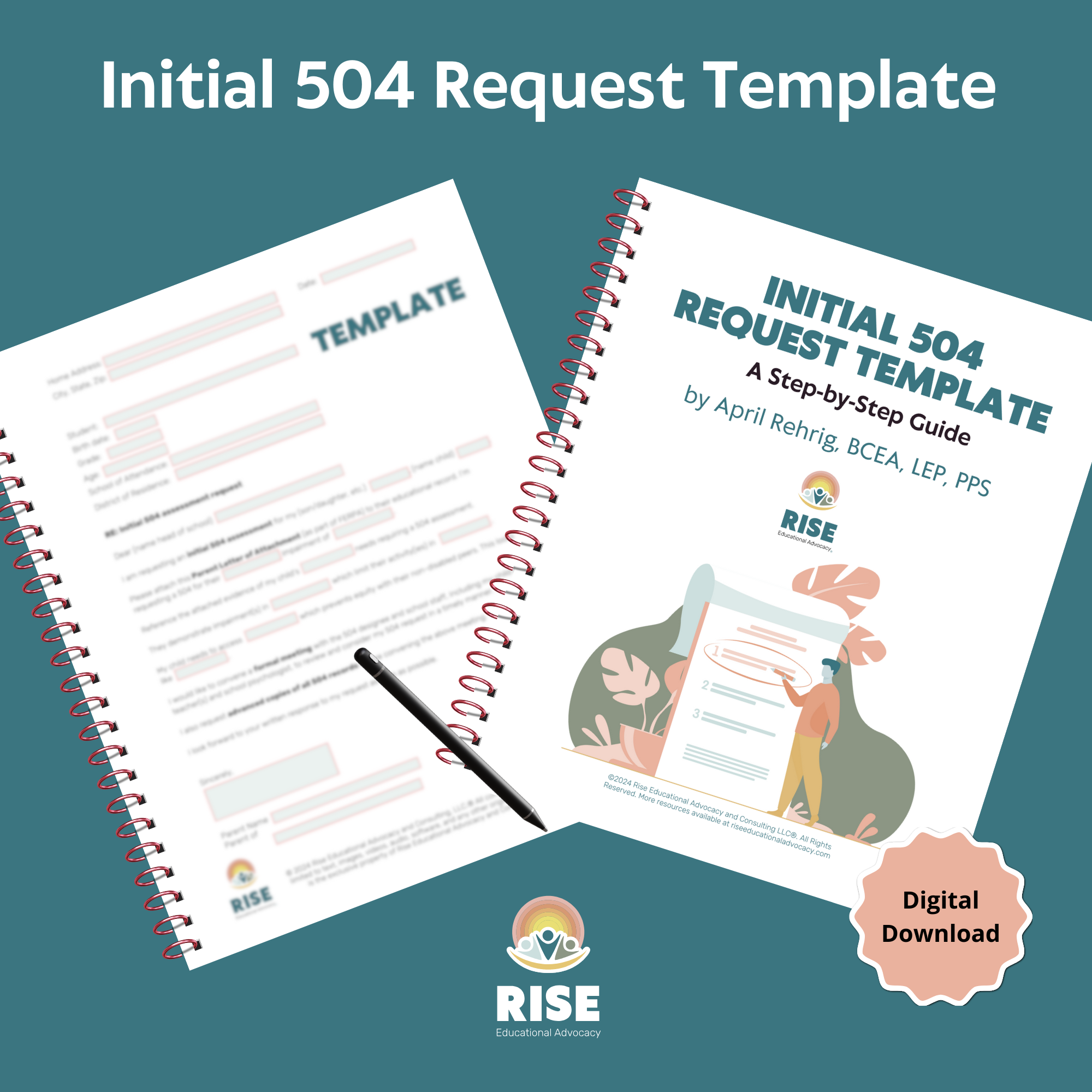 Send your Parent Request Letter by email to the principal, school counselor, teacher, nurse, or 504 coordinator.
Send it to the highest-ranking school administrator and copy anyone who works closely with your child.
Your request should include your child’s name, the diagnosis or suspected impairment, how the impairment impacts school, which major life activities are affected, and that you are requesting a 504 evaluation or a 504 meeting.
Parent Request Letters help schools understand that you are requesting a formal 504 process rather than a casual conversation.
What Documents Should Parents Bring to a 504 Meeting?
Before your 504 meeting, gather documents that show your child’s history of needs.
You don't need a giant binder. But you do want to bring information that shows how your child’s disability impacts school.
Bring copies of your Parent Request Letter, meeting notice, medical documentation, private evaluations, teacher emails, work samples, grades, attendance records, discipline records, MTSS or RTI data, therapy recommendations, and your requested 504 accommodations.
Here is my biggest parent tip:
Don’t only talk about the diagnosis. Talk about the school impact.
Instead of saying:
“My child has anxiety.”
Say:
“My child’s anxiety causes stomachaches before school, nurse visits, missed class time, trouble taking tests, and difficulty in group tasks.”
That gives the 504 team clearer information.
What Happens at a 504 Meeting?
Unlike an IEP, there's no one set blueprint for every 504 Plan. Schools may use different forms and meeting formats.
But the 504 team should include people who know your child, understand the evaluation information, and understand school support options.
This may include a teacher, school counselor, school psychologist, school nurse, intervention teacher, administrator, 504 coordinator, and parent or guardian.
Your team should review the information and ask:
- Does your child have a physical or mental impairment?
- Does it substantially limit one or more major life activities?
- Do they need accommodations, aids, services, or supports to access school?
For more help with 504 meetings, watch our video:
What Are 504 Plan Accommodations? Examples and What to Ask For
Accommodations are a huge part of 504 Plans.
Below you'll find 504 plan examples of common accommodations organized by category, so you know exactly what to ask for.
A 504 accommodation changes how your child accesses learning, shows what they know, or participates in school. Accommodations don't change what your child is expected to learn. They help level the playing field.
Common accommodation categories include:
- Presentation: how information is given
- Response: how the student answers or completes work
- Setting: where the student learns or tests
- Timing and scheduling: when or how long the student works
Examples of 504 Plan accommodations include extended time, reduced-distraction testing, preferential seating, movement breaks, written directions, copies of notes, assignment chunking, planner checks, nurse access, bathroom breaks, water or snack access, safe person check-ins, a break card, make-up work plan, behavior supports, or small group testing.
Learn more about Accommodations vs. Modifications: What’s the Difference?
504 Plans can also support behavior needs. If your child has discipline challenges, you may want to request a Behavior Intervention Plan (BIP) or even a Functional Behavioral Assessment (FBA).
What Needs to Be Inside a 504 Plan?
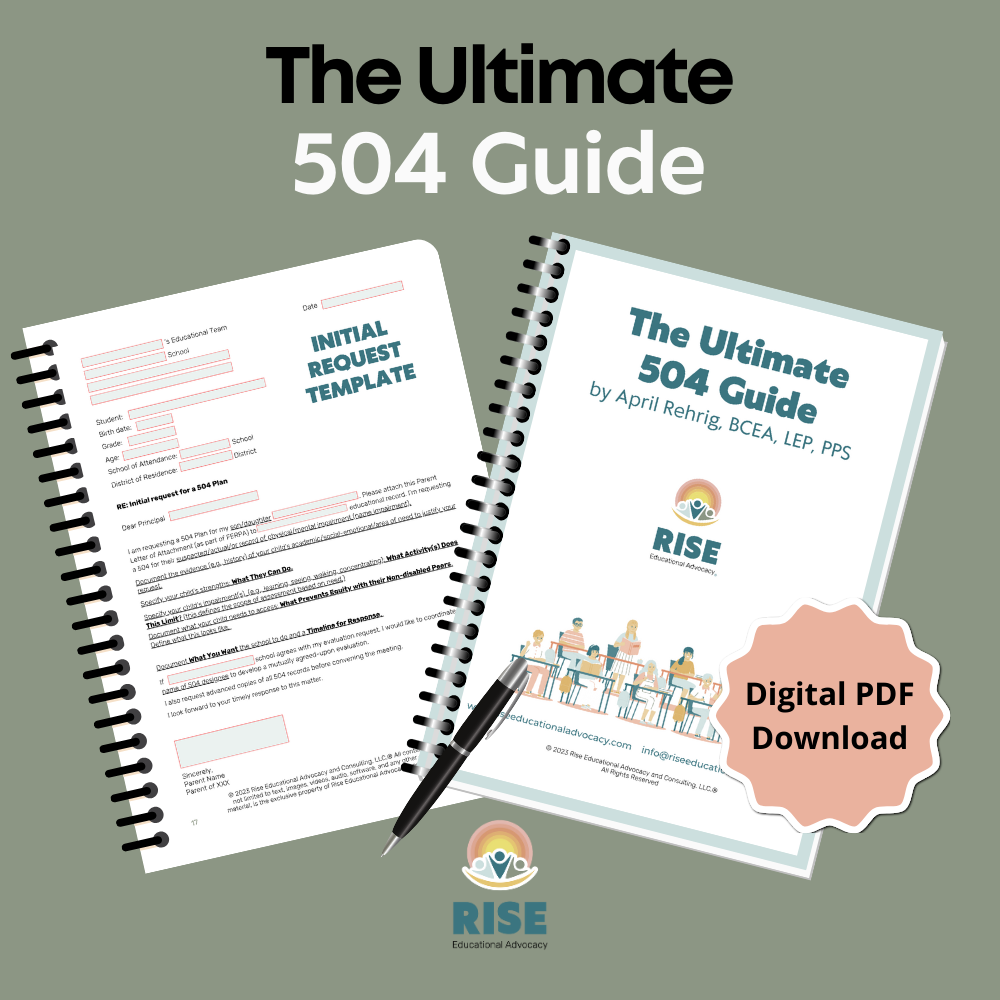
A strong 504 Plan should be clear.
It must explain what the accommodation is, when and where it will occur, who will provide it, and how it will help your child access school.
Watch out for vague words like:
- “as needed”
- “when possible”
- “when available”
- “may request”
These are common in 504 Plans, but make them hard to follow.
For example, “breaks as needed” may sound helpful. But what if your child is too anxious to ask for a break or relies on teacher permission?
A clearer accommodation may say:
“Student can request a break card or private signal for a five-minute break in an agreed-upon location.”
 That tells the school what to do and how to implement accommodations with fidelity.
A 504 Plan is part of your child’s educational record.
Parents have the right to access educational records, and you can request a copy of your child’s current 504 Plan and related records.
Also, a 504 Plan doesn’t “expire.” If your child moves to a new public school, the new school should review the Plan. If they want to change or remove support, ask for the decision and process in writing.
What If the School Says My Child Does Not Qualify?
When schools say your child doesn’t qualify for a 504 Plan, ask for the decision in writing.
You can ask:
- What information did the team review?
- Why do they believe my child does not qualify?
- Can I have the written decision?
- Can I get a copy of the district’s 504 policies and safeguards?
- What data does my team need to reconsider eligibility?
You also have the right to disagree with your school’s decision and ask about the district’s Section 504 dispute process, complaint options, or due process procedures.
A verbal “no” is not enough for parents to understand the decision. Ask the school to explain the reason in writing.
504 Plan vs. IEP: What Is the Difference?
 Parents often ask: Does my child need a 504 Plan or an IEP?
Here's the simple difference.
A 504 Plan provides accommodations, access supports, and sometimes services so a student can participate in school.
An IEP gives special education, related services, specialized academic instruction, IEP goals, accommodations, and placement when a child qualifies under IDEA.
Some children need a 504 Plan. Some children need an IEP.
If your child needs specialized instruction, IEP goals, related services, or special education, you may need to ask for an IEP evaluation.
If your child mainly needs access supports or school accommodations, a 504 Plan may be the right place to start.
Both IEPs and 504 Plans include protections. Both can support your child’s right to a Free Appropriate Public Education, also called FAPE. Learn more about an IEP vs. 504 Plan: Understand the Difference and Choose Right.
Final Thoughts on 504 Plans for Parents
A 504 Plan is not just a piece of paper.
It shouldn’t be a vague promise of help.
A strong written 504 Plan must explain what your child needs, who will support them, and how your school will remove barriers so your child can access learning.
If your child is struggling, don’t wait for the school to bring up a 504.
- Put your request in writing.
- Bring documentation.
- Ask questions.
- Know your 504 rights.
- Ask for clear accommodations.
You can meaningfully participate in the 504 process. And your child deserves a 504 Plan that’s clear, supportive, and built on needs.
Ready to Build a Better 504?
Need help preparing for your 504 meeting? Rise Educational Advocacy helps parents understand what to ask for and how to build stronger school support plans.
At Rise Educational Advocacy®, we help parents navigate 504 Plans and IEPs. Through expert advocacy, parent IEP coaching, IEP workshops, and practical guides, we show you how to advocate like a pro.
Book a parent consultation today.
April Rehrig, BCEA, LEP, PPS, CASDCS, is the owner and founder of Rise Educational Advocacy and Consulting, LLC.