
Can a Gifted Child Get an IEP? What Parents of Twice-Exceptional Students Should Know
Guest blog by Joanna Cheng, PPS, LEP, founder and director of Leap Center
If your child seems incredibly bright in some areas but struggles in others, you’re not imagining things, and you’re not alone.
Many parents find themselves confused when a child who can read years above grade level, or has a remarkable memory, or can do math beyond their age, also melts down over homework, avoids writing, or can’t stay organized.
This apparent contradiction often serves as a hallmark of a twice-exceptional learner.
Understanding how giftedness and learning challenges can coexist, and how to support a child who has both, is essential to ensuring they get the help they need. Let’s walk through what this means and what you can do next.
The Paradox of the Gifted Child
Gifted children are often assumed to be high-achieving across the board. But that’s not always the case.
Some gifted students:
- Excel in verbal reasoning but struggle with writing
- Show advanced math thinking, but makes frequent careless errors
- Have deep curiosity but poor attention or follow-through
- Seem intellectually mature but emotionally younger than peers
This uneven development can be confusing for parents and teachers alike. A child may be labeled as “lazy,” “unmotivated,” or “not working up to potential,” when in reality they are working twice as hard just to stay afloat.
This is where the paradox lies: a child can be both advanced and challenged at the same time.
What Is Twice-Exceptional (2e)?
A twice-exceptional (2e) child is one who is both:
- Gifted (demonstrating high ability or potential), and
- Has a disability (such as ADHD, a learning disability, anxiety, or autism)
These two aspects don’t cancel each other out; they interact in complex ways.
For example:
- A gifted child with ADHD may generate brilliant ideas but struggle to complete tasks
- A child with dyslexia may have exceptional verbal reasoning but avoid reading
- A highly creative thinker may also experience significant anxiety that impacts performance
Because strengths and challenges can mask each other, 2e students are often misunderstood.
 Why Twice Exceptional Students Are Often Missed
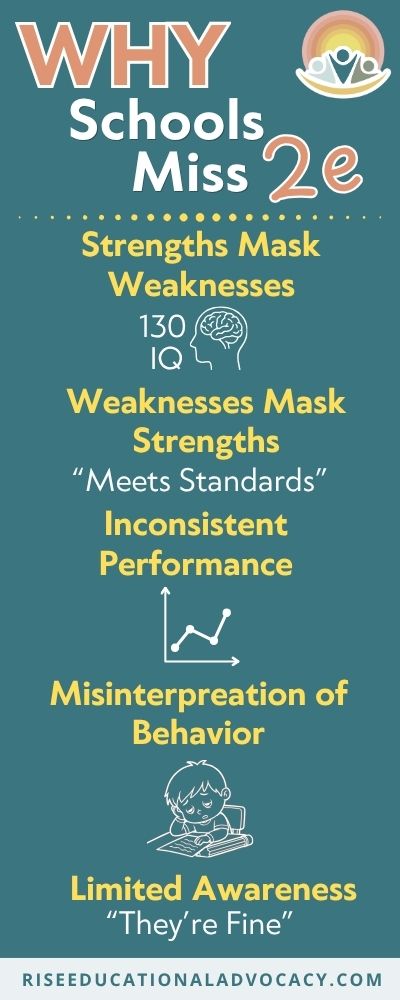
Many 2e students go unidentified for years. Here’s why:
- Strengths mask weaknesses
A bright child may compensate for a learning difficulty well enough to avoid detection until academic demands increase. - Weaknesses mask strengths
If a child is struggling significantly (e.g., with reading or attention), their giftedness may go unnoticed because their performance doesn’t reflect their potential. - Inconsistent performance
2e students often have uneven results, high scores in some areas, low scores in others, which can be dismissed as a lack of effort rather than a meaningful pattern. - Misinterpretation of behavior
Frustration, avoidance, or emotional outbursts may be seen as behavioral issues rather than signs of underlying learning differences. - Limited awareness in schools
Not all schools are equipped to recognize or assess twice-exceptionality, especially when students don’t fit typical profiles.
Identifying the Signs of a Twice-Exceptional Learner
While every child is different, some common indicators of 2e profiles include:
- Advanced vocabulary or deep knowledge in specific topics
- Strong problem-solving or abstract reasoning skills
- Intense curiosity and creativity
- Difficulty with organization, time management, or task completion
- Avoidance of certain academic tasks (especially writing or reading)
- High sensitivity, perfectionism, or emotional intensity
- Large gap between verbal ability and written output
- “Underachievement” relative to perceived ability
You might hear comments like:
- “They’re so smart, but they just don’t apply themselves.”
- “If they would just try harder…”
- “They understand everything when we talk, but can’t show it on paper.”
These are often red flags that something deeper is going on.
Can You Get an IEP for a Twice Exceptional Child?
Yes, a gifted child can qualify for an IEP if they meet the criteria for a disability that impacts their ability to access the curriculum.
An Individualized Education Program (IEP) is designed to provide specialized instruction and services for students with identified disabilities under federal law.
Giftedness alone does not qualify a child for an IEP. However, if your child also has:
- A specific learning disability (e.g., dyslexia, dysgraphia)
- ADHD
- Autism
- Emotional disturbance (e.g., severe anxiety impacting school functioning)
- Speech or language impairment
…and if that condition significantly affects their education, they may be eligible.
Important point:
A child does not have to be failing to qualify for an IEP. If their disability is preventing them from fully accessing their education, even if they are earning average or above-average grades, they may still be eligible.
For 2e students, this is especially important because their strengths often mask the true level of struggle.
 IEP vs. 504 Plan: Which Is Right for Your Child?
Both IEPs and 504 Plans provide support, but they serve different purposes.
IEP (Individualized Education Program)
- For students who qualify under specific disability categories
- Provides specialized instruction and measurable goals
- Includes related services (e.g., speech therapy, counseling)
- Legally binding and highly structured
504 Plan
- For students with a disability that impacts access but may not require specialized instruction
- Provides accommodations (e.g., extra time, preferential seating, reduced workload)
- Less formal than an IEP, but nevertheless legally binding
- Does not include specialized instruction
Which is better for a 2e child?
It depends on the level of need.
- If your child needs explicit teaching and access supports to remediate a skill deficit, an IEP is typically more appropriate.
- If your child needs access supports (e.g., extended time, breaks, flexibility), a 504 Plan may be sufficient.
Some 2e students need both enrichment for their strengths and support for their challenges, but schools don’t always address both sides equally. That’s where advocacy becomes critical.
How to Advocate for Your Child: What To Do Next
If you suspect your child may be twice exceptional, here are practical steps to take:
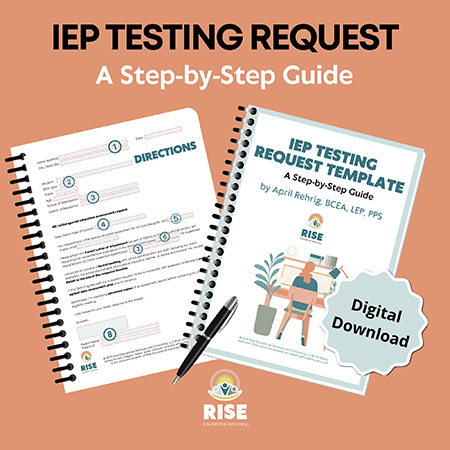
1. Seek a Comprehensive Evaluation
A thorough psychoeducational assessment can:
- Identify both giftedness and areas of difficulty
- Clarify learning profiles and discrepancies
- Provide specific recommendations for school and home
Look for an evaluator who understands gifted and 2e profiles; not all assessments are designed to capture this complexity.
2. Review the Results Carefully
Pay attention to:
- Patterns (not just overall scores)
- Strengths vs. weaknesses
- Discrepancies between verbal, visual, and processing skills
- Executive functioning and attention
- Behaviors pointing to possible neurodivergence
These insights are key to building the right support plan.
3. Request a School Meeting
You can formally request an evaluation or meeting with your child’s school team. Bring:
- Your concerns
- Any private evaluation reports
- Specific examples of struggles
Use clear language like:
“I’m concerned that my child’s difficulties in (area) are impacting their ability to access the curriculum, despite their strengths in (area).”
4. Know Your Rights
Parents have the right to:
- Request evaluations
- Participate in eligibility decisions
- Disagree with the school's findings
- Request independent evaluations (in some cases)
Understanding this can help you advocate more effectively.
5. Focus on Both Strengths and Needs
One of the biggest pitfalls for 2e students is that only one side of the profile gets addressed.
Your child needs:
- Support for challenges (e.g., reading intervention, executive functioning support)
- Opportunities to develop strengths (e.g., advanced coursework, enrichment, creative outlets)
Both are essential for long-term success and self-esteem.
6. Monitor and Adjust
Support plans should evolve as your child grows.
Stay in communication with teachers and:
- Track what’s working
- Adjust accommodations as needed
- Reevaluate periodically
Final Thoughts
Twice-exceptional children often live in a space of contradiction, capable yet struggling, insightful yet overwhelmed. Without the right support, they can become discouraged, misunderstood, and disengaged.
But when their full profile is recognized, everything can change.
With the right identification, appropriate supports, and strong advocacy, 2e students can not only succeed but truly thrive.
If your child feels like a puzzle that doesn’t quite fit traditional expectations, trust that instinct. Sometimes, the very traits that make things difficult are also the ones that make your child exceptional.
 Joanna Cheng is a Licensed Educational Psychologist and school psychologist with over 20 years of experience supporting children, teens, and families. She specializes in gifted and twice-exceptional (2e) testing and comprehensive psycho-educational evaluations, helping parents understand and support their child’s unique strengths and needs.
With experience across public, private, and gifted education, including serving as a psychologist for the GATE program, she brings deep expertise in learning and development through a strengths-based lens.
Joanna partners closely with families to provide clear, actionable guidance and is bilingual in English and Mandarin, supporting diverse families with care and insight.
Reach out to Leap Center to custom-tailor support for your child.
Joanna Cheng, PPS, LEP, is the founder and director of Leap Center in Los Angeles, California