

What is FASD? A Parent’s Guide to FASD Diagnosis and IEP Accommodations
Guest blog by Sarah Vakharia, LEP, ABSNP, and Karen Veinbergs, LEP, ABSNP, Board Certified School Neuropsychologists
Did you know Fetal Alcohol Spectrum Disorders (FASD) affect as many as 1 in 20 children in the United States?
That’s more common than autism and Down Syndrome combined. Yet, FASD is often called the “invisible disability” because most kids don’t have obvious physical features, and their challenges are frequently misunderstood or missed entirely.
For parents and educators, helping a child with FASD thrive in the school system can feel like an uphill battle. Behaviors are misinterpreted, the wrong interventions are applied, and families are left feeling exhausted.
Here’s what schools often miss about FASD and what you need to know to unlock your child’s fullest potential.
1. What is FASD?
FASD is an umbrella term for a range of physical, mental, behavioral, and learning disabilities that can happen when a child is exposed to alcohol before birth. It is a brain-based physical disability.
Prenatal alcohol exposure can permanently change how the brain develops, especially in areas that control impulse, memory, and communication between brain hemispheres.
FASD isn’t just one condition; it’s a spectrum. Some children have visible signs, like distinct facial features or growth delays (FAS and partial FAS), while others may only struggle with learning, behavior, or daily routines (ARND and ND-PAE) without any outward clues. Some kids may also have physical issues like heart or kidney problems (ARBD).
Every child’s experience is unique, so understanding the types of FASD helps you find the right support.
 2. How FASD Shows Up in School
At school, FASD often gets mistaken for “bad behavior,” laziness, or defiance. This is the biggest misconception educators face.
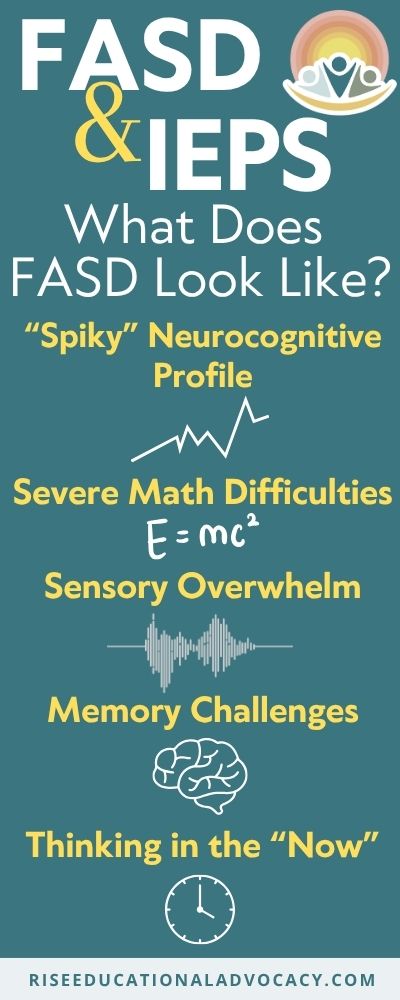
Children with FASD have what’s called a "spiky” neurocognitive profile. For example, they might speak well but struggle to understand instructions or manage daily living tasks. They often function at a developmental age much younger than their actual age.
Common signs include:
- Severe Math Difficulties: Abstract concepts such as time and money are especially challenging for kids with FASD.
- Sensory Overwhelm: Loud noises, certain textures, or even clothing tags can trigger big reactions.
- Memory Challenges: Sometimes called “Swiss cheese memory,” your child might remember a spelling list one day and forget it the next. It’s not laziness; their brain just didn’t store the information.
- Thinking in the "Now”: Kids with FASD often struggle to connect their actions to future consequences. They live in the present, so “if/then” discipline rarely works.
If your child can’t follow a three-step instruction, it’s easy to think they’re being defiant. In reality, their brain may have "timed out" after the first step.
Recognizing this as a “can’t do” rather than a “won’t do” is the first step to unlocking their true potential.
3. IEP Eligibility Pathways
A medical diagnosis of FASD doesn’t automatically qualify a student for special education services, and you don’t need a medical FASD diagnosis to get an Individualized Education Program (IEP). In schools, eligibility is based on educational need, not just the medical label.
Schools often place children with FASD under the “Emotional Disturbance” (ED) category because of behavioral meltdowns. This can be a mismatch.
ED interventions assume the child can change behavior through rewards and consequences, but kids with FASD usually lack the cognitive skills for this.
A thorough neurobehavioral evaluation by a specialized team can help guide the IEP team toward more appropriate categories. Many students with FASD are best served under:
- Other Health Impairment (OHI): Recognizes the brain-based nature of executive functioning and attention deficits.
- Specific Learning Disability (SLD): Especially in math, as abstract reasoning is a common area of weakness.
 4. Research-Based Supports for Kids with FASD: What Works
Because internal regulation is impaired, caregivers and teachers must become the child’s “External Brain.” We can’t force the brain to fit the environment; we must change the environment to fit the brain.
The 8 Magic Keys to Support
- Concrete: Use simple, clear language, avoid jokes or sarcasm.
- Consistency: Keep routines and expectations the same every day.
- Repetition: Be ready to reteach skills often, sometimes hundreds of times.
- Routine: Predictable schedules help reduce anxiety.
- Simplicity: Keep surroundings calm and uncluttered.
- Specific Instructions: Give one direction at a time.
- Structure: Set clear boundaries and use “stop/go” cues.
- Supervision: Extra “eyes-on” time helps with safety and social situations.
Becoming the “External Brain”
Kids with FASD need caregivers and teachers to help organize their day and manage emotions. Use visual schedules, checklists, timers, and offer calm support when your child is overwhelmed.
Targeted FASD Therapy Options
Math Skills
MILE (Math Interactive Learning Experience): Targeted math tutoring for children with FASD. Parents also learn strategies for positive behavioral support at home. Research shows kids in MILE make gains in math and behavior.
Self-Regulation
The Alert Program: A 12-week curriculum teaching self-regulation skills using a “car engine” analogy. Kids learn to recognize when their “engine” is running too fast or too slow and how to manage it. It improves emotional control and executive functioning.
Social Skills
Good Buddies (Children's Friendship Training): A 12-week social skills program for kids ages 6–12 with FASD, plus parent training. It improves social skills and reduces misinterpretation of social situations.
Remember: Kids with FASD need ongoing support, not just accommodations. Changing the environment and using these proven strategies can make a big difference for your child at home and school.
Additional Research-Based Interventions for Children with FASD
5. Discipline and Manifestation
Standard behavior management, such as point charts, taking away recess, or detention, relies on a child’s ability to remember rules, control impulses, and understand cause and effect. For a child with FASD, these methods almost always fail and can escalate behavior.
When a child with FASD “acts out” or “tests” a new teacher, it’s rarely manipulation. It’s “certainty seeking,” looking for adults to provide the boundaries and structure they can’t create for themselves.
If a reward system is used, make it progressive. Never take away earned tokens for misbehavior, as this can trigger “all-or-nothing” meltdowns and hopelessness.
IEP behavior plans should focus on preventing overload before it happens, recognizing that resistance is often rooted in anxiety, sensory overload, and neurological impairment.
6. Parent Advocacy Scripts (What to Say in an IEP Meeting as a Parent)
Advocating for a child with FASD can be exhausting. Here are a few scripts you can bring to your next school meeting:
When schools suggest kids "choose" to be defiant:
"I understand it looks like defiance, but a neurobehavioral evaluation shows my child has significant executive functioning deficits. This isn't a 'won't do' situation; it's a 'can't do' neurological reality. We need to look at what triggered the sensory or cognitive overload."
When schools use standard consequences/punishment:
"Traditional discipline relies on an intact working memory and the ability to grasp cause-and-effect, both of which my child's brain struggles with due to FASD. Taking away recess will only increase their dysregulation. How can we act as their 'external brain' and prevent this trigger next time?"
When schools say kids did tasks perfectly before:
"Individuals with FASD have highly variable, sporadic memory recall. Mastering a task one day and forgetting it the next is a hallmark symptom of their brain difference. They aren't being lazy; they need us to patiently reteach the concept using the 'Repetition' key."
When fighting for IEP eligibility (OHI vs. ED):
"While my child has behavioral outbursts, these are secondary symptoms of an underlying, brain-based physical disability. Categorizing them as having an Emotional Disturbance will lead to behavioral interventions that rely on impulse control they don't have. Other Health Impairment (OHI) accurately reflects that their behaviors are a symptom of a neurodevelopmental impairment."
Watch: What is FASD? Where I sit down with Sarah to discuss HOW schools can better support students in getting sound evaluations and meaningful IEPs.
Getting the Right FASD Evaluation Makes All the Difference
Children with FASD are loving, creative, determined, and loyal. To let those strengths shine, adults need to understand how their brains work.
Because FASD overlaps with ADHD, trauma, and autism, getting an accurate, comprehensive neuropsychological evaluation is critical. Psycho-Educational Consultants (PEC) Group specializes in strength-based neurobehavioral assessments that go beyond basic IQ scores to identify the gap between intelligence and real-world skills.

Reach out to PEC Group to help your child reach their full potential.
Sarah Vakharia, LEP, ABSNP, and Karen Veinbergs, LEP, ABSNP, are Board Certified School Neuropsychologists and owners of PEC Group in San Diego, California