
What is an FBA in Special Education? A Parent’s Guide to Functional Behavior Assessments
If your child is having a hard time with behavior at school, you may be getting calls, emails, or requests for an IEP meeting.
Your school may suggest an FBA in special education, also called a Functional Behavior Assessment.
If you’re like most parents, you may be wondering how an FBA can help your child. Behavior is not just something to stop or "fix". Often, it's a sign that your child is overwhelmed, dysregulated, or in need of more support.
A Functional Behavior Assessment helps your IEP or 504 team look deeper, understand what your child may be communicating, and find better supports for school success.
To make sense of your journey, learn more about the IEP process for parents.
 What Does FBA Stand for?
FBA stands for Functional Behavior Assessment. It is a problem-solving process used by school teams to understand the 'why' behind a student's challenging behavior and to identify the specific triggers and reinforcements that maintain it.
In simple terms, FBAs answer questions like:
- What is your child doing?
- When does it happen?
- Where does it happen?
- What takes place before, during, and after the behavior?
- Why is your child doing it?
This matters because behavior is a form of communication. Your child may be overwhelmed, anxious, or confused. They could be escaping something that’s too hard, need direct teaching, or a different approach.
When is an FBA in Special Education Necessary?
An FBA in special education is warranted when behavior impedes your child’s ability to learn, participate, self-regulate, or remain safe.
Common referral reasons include:
- Task or school refusal
- Inattention or inappropriate behavior
- Shutting down
- Verbal or physical aggression
- Self harm
- Elopement
- Challenging transitions
A strong FBA helps teams ask the right questions:
Why is the behavior occurring? What does your child need? Which supports are missing, and how do we address their needs?
If your child already has special education, learn more about the special education assessment process to get help.
Can Your Child Get an FBA With a 504 Plan?
Yes. Students can get an FBA with a 504 Plan, not just an IEP.
Behavior goes beyond special education and IDEA Law. If your child has a 504 Plan and behavior impacts their access and equity, request an FBA in writing.
Parents are often told that FBAs can only be done through an IEP. This is simply NOT true. If your child is struggling, ask how your school is addressing the need and if an FBA is warranted.
Why Do Schools Conduct Functional Behavior Assessments?
 Schools conduct a Functional Behavior Assessment when behavior impedes learning, participation, safety, or school success. Schools may say they only conduct FBAs when behavior is “severe”, when in fact there’s no required threshold. If schools deny your written request and your child has an IEP, they must provide Prior Written Notice (PWN).
When Behavior Impacts Learning
If behavior impedes learning, teams need accurate data to understand what’s happening and how to deliver appropriate supports to your child.
When New Behaviors Develop
If new behaviors emerge, teams must look for patterns, triggers, and changes in your child’s performance.
When Discipline is a Problem
When your child continues to have challenges, teams must look beyond consequences. They need to ask whether your child needs different supports or direct instruction to address their needs.
Before Changing Placement
Before considering a change in placement to a more restrictive setting, such as a self-contained class, a Functional Behavior Assessment is warranted.
The 5-Step Process: What Does an FBA Look Like?
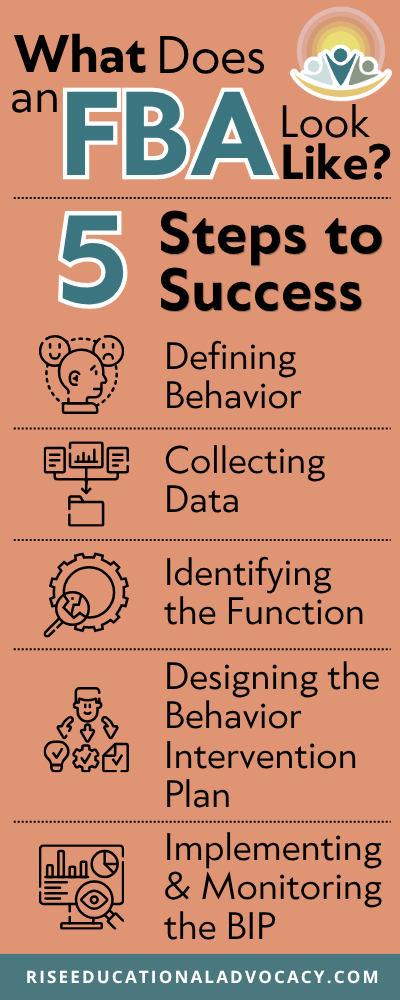
A comprehensive Functional Behavior Assessment is not just guesswork. It’s a highly strategic 5-step process that looks at the entire picture of what your child can do, can’t do, needs to learn, and barriers to learning.
1. Defining Behavior
Schools must identify and prioritize the target behaviors.
They must use objective, specific, and measurable terms when describing what behavior looks like. Watch out for vague or subjective language that says what adults see, but not what your child is experiencing.
Teams should describe a clear picture, spelling out what your child is actually doing, so everyone is talking about the same thing.
 2. Collecting Data
Teams will gather information about when, where, and with whom challenging behavior occurs using indirect and direct methods. Teams often use the ABCs of behavior:
- Antecedent: what happens before (trigger)
- Behavior: what behavior occurs
- Consequence: what happens after (result)
This helps teams identify observable and measurable patterns instead of making assumptions.
3. Identifying the Function of Behavior
One of the MOST important parts of an FBA.
Teams must develop a hypothesis or “best guess” statement explaining why behaviors occur.
For example, is your child:
- Escaping a task?
- Avoiding transitions?
- Seeking attention?
- Responding to sensory needs?
Unless schools identify the function, they create behavior plans that don’t match the need.
4. Designing the Behavior Intervention Plan
After an FBA is complete, most teams develop a Behavior Intervention Plan (BIP).
A comprehensive Behavior Intervention Plan must include:
- Supports to prevent behavior
- Environmental changes
- Teaching replacement behavior
- Progress monitoring to track effectiveness
Behavior plans shouldn’t just focus on what happens after a child struggles. They must prevent challenges and teach new skills to improve functional independence.
Learn more about 5 Behavior Management Strategies to Increase Kids' Independence.
5. Implementing and Monitoring the BIP
Teams can’t just create a BIP and then forget about it.
They must implement the plan as written, monitor its effectiveness, and modify the plan if changes are needed.
Who Is Involved in Your Child’s FBA?
 An FBA in special education may involve several team members.
This may include:
- School psychologists
- Counselors
- General education teachers
- Special education teachers
- Behavior staff or BCBAs
- Related support providers
- Other school team members involved with your child
Just as important, as parents, you’re part of the FBA team.
This means your input matters because you know your child best, you’ve been on the team the longest, and you have a wealth of knowledge.
Red Flags: What to Watch Out For in a School FBA
Not every Functional Behavior Assessment is done appropriately.
Trust your instincts and ask questions when:
- Behavior isn’t clearly defined
- There’s little or no observational data
- Your input is missing or not considered
- Teams only focus on consequences
- BIPs don’t spell out what support will be delivered and how
Sometimes what looks like a behavior problem is actually a teaching problem.
This means your child may need:
- New accommodations
- Direct teaching or staff training
- Paraeducator support
- Sensory tools
- Assistive technology
- A prompt hierarchy or fade-out plan
- Speech, communication, or academic support
Don’t be afraid to ask what your school will do differently and how they’ll change the IEP or 504.
How to Formally Request an FBA for Your Child
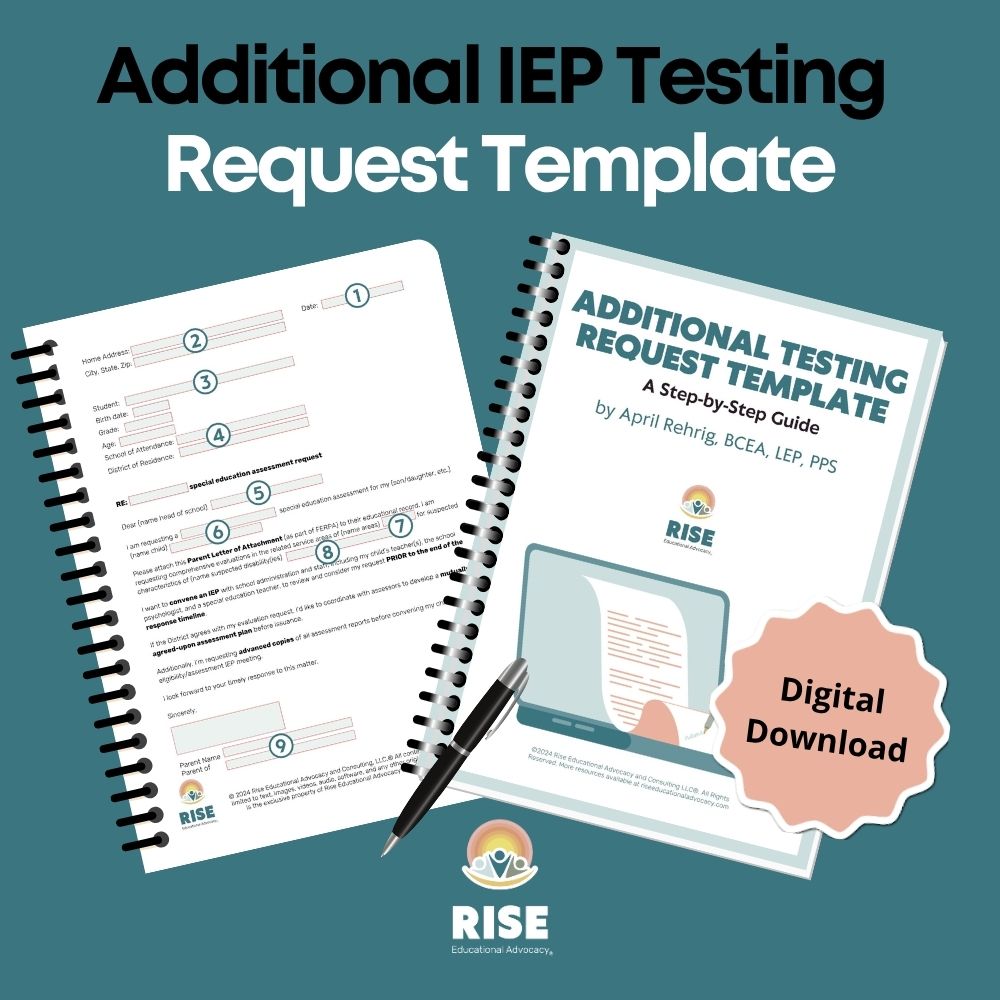 If your child’s behavior is affecting access to school or learning, you have the right to request an FBA.
You might say:
“My child’s behavior is impacting learning and their ability to get a Free Appropriate Public Education (FAPE). I’m formally requesting an FBA for my child.”
Always put assessment requests in writing and expect a written response from the school. Before meeting with your team, ask yourself:
- When does the behavior happen?
- What triggers it?
- What helps?
- What has the school done?
- Does the behavior occur when my child is dysregulated, during transitions, or in interactions with adults?
Final Thoughts on FBAs for Parents
If your child is struggling with behavior at school, you deserve more than vague explanations or discipline-based responses.
You deserve clear information.
You deserve thoughtful problem-solving.
And your child deserves support that is individualized, respectful, and based on real need.
A strong Functional Behavior Assessment can help the team identify triggers, understand the function of your child’s behavior, and create a plan that better supports your child at school.
Need a Simple Walkthrough of FBAs?
If you want a parent-friendly explanation of how FBAs work, watch my YouTube video: What is an FBA in Special Education? Functional Behavior Assessment Explained. In the video, I break down what an FBA is, why schools use Functional Behavior Assessments, what you should listen for in meetings, and how behavior support should focus on understanding your child’s needs.
Ready to Build a Better IEP or 504?
At Rise Educational Advocacy,® we help parents navigate FBAs by securing the best IEP or 504 Plan to help your child. Through my advocacy services, IEP workshops, and practical guides, I show you how to turn overwhelming IEPs or 504s into strength-based education plans.
Understand your parent rights, navigate your safeguards, and advocate with confidence. Get started today with a parent consultation.
April Rehrig, BCEA, LEP, PPS, CASDCS, is the owner and founder of Rise Educational Advocacy and Consulting, LLC.