

Early Signs of Dyslexia Parents Often Miss — And When to Act
Guest blog by Megan Pinchback, MBA, LDT, CALT, owner and founder of Dyslexia On Demand
Many families are told to “wait and see” when a child struggles with early reading skills.
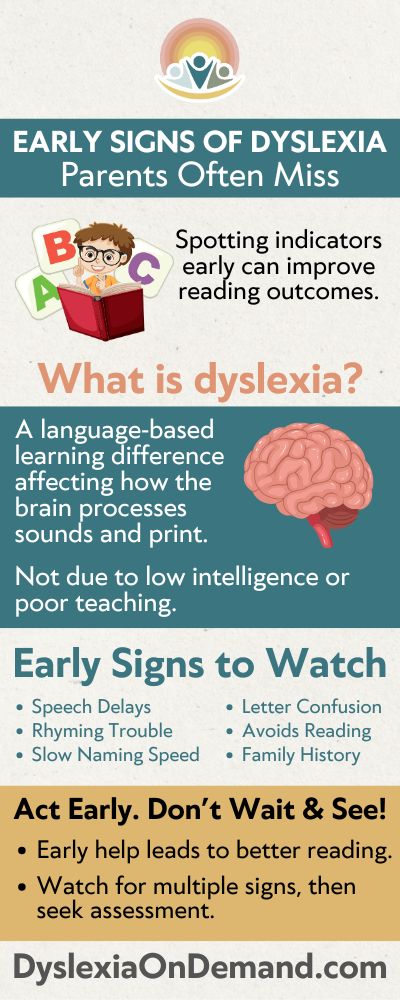
But the early signs of dyslexia often appear before formal reading instruction even begins. These indicators may show up in speech development, sound awareness, memory for language, and task avoidance- not just reading failure.
Because the signs are spread across multiple areas, they are easy to overlook or misinterpret. Early recognition of dyslexia matters because timely, structured intervention improves long-term reading and writing outcomes and protects a child’s confidence.
Dyslexia is a language-based learning difference that affects how the brain processes speech sounds and connects them to print. It is not caused by low intelligence, poor teaching, or lack of motivation.
Speech and Language History Can Signal Dyslexia Risk
One of the strongest early predictors of dyslexia is a history of speech or language differences. Many children later identified with dyslexia experienced delayed speech development, persistent articulation errors, or difficulty with sound blends. Some received speech therapy during preschool or early elementary years.
Speech and reading share the same phonological foundation in the brain. When early sound processing or sound production is weak, later sound-symbol mapping for reading becomes more difficult. Longitudinal research consistently links early phonological weaknesses with later decoding challenges (Snowling, 2000; Catts et al., 2005).
Not every child with speech delay develops dyslexia, but speech history should raise awareness when reading progress is unexpectedly slow.
 Difficulty With Rhyming and Sound Play
Another commonly missed early sign of dyslexia is difficulty with rhyming and sound play. Before children can read words visually, they must understand that words are made of smaller sound units- a skill set known as phonological awareness.
This includes:
- Recognizing rhymes
- Identifying beginning sounds
- Segmenting syllables
- Blending sounds together
Children at risk for dyslexia often struggle with these tasks even when they are bright and talkative. Rhyming games may feel confusing. Sound manipulation tasks may be unusually difficult.
Research shows that phonological awareness is one of the strongest early predictors of reading success or reading difficulty (Wagner & Torgesen, 1987; Melby-Lervåg et al., 2012). Because these activities are playful and oral, adults sometimes assume difficulty is due to attention- when it is actually an early literacy warning sign.
Inconsistent Letter Learning and Letter-Sound Confusion
Many young children reverse letters during early instruction. That alone is not unusual. What raises concern is inconsistent letter knowledge despite repeated exposure.
Children at risk for dyslexia may:
- Learn letters one day and forget them the next
- Confuse visually similar letters
- Mix up letter sounds repeatedly
- Struggle to form stable letter-sound connections
This pattern reflects weaknesses in phonological memory and symbol-sound association, not lack of effort. Research on early reading acquisition identifies unstable letter-sound mapping as a hallmark of dyslexia risk (Ehri, 2005; Shaywitz, 2020).
Strong Listening Skills But Weak Early Reading
A gap between listening comprehension and early reading ability is another important dyslexia indicator. Some children show advanced vocabulary and strong verbal reasoning when text is read aloud — yet struggle to decode even simple words independently.
This discrepancy is meaningful. It suggests language comprehension is intact while word-level reading processes are impaired. Dyslexia primarily affects decoding and word recognition, not intelligence (Lyon et al., 2003; Shaywitz, 2020).
When oral understanding significantly exceeds reading performance, early screening is appropriate.
 Early Spelling and Writing Red Flags
Early writing and spelling patterns often provide important clues. Children at risk for dyslexia frequently produce spelling attempts that do not accurately represent the sounds in words.
You may notice:
- Missing sounds in spelling
- Sound order confusion
- Guess-based spelling
- Weak phonetic representation
These patterns reflect difficulty with phoneme segmentation and encoding. Research shows early phonological spelling errors are closely tied to later decoding difficulty (Treiman, 2017).
Writing may also feel unusually effortful, leading to early avoidance of drawing and writing tasks.
Avoidance of Reading and Writing Tasks
Avoidant behaviors are often misunderstood. A child who repeatedly struggles with early literacy tasks may try to escape them- but this can look like distraction, silliness, or defiance.
You might see:
- Frequent break requests
- Acting out during literacy tasks
- Emotional shutdown
This is often interpreted as a motivation issue when it is actually a stress response to cognitive overload. Research shows repeated academic difficulty can trigger protective avoidance patterns even in capable learners (Morgan et al., 2008).
Slow Naming and Retrieval Speed
Difficulty with rapid retrieval and automatic sequences is common in children later diagnosed with dyslexia. They may struggle to quickly name familiar items or recall learned sequences.
Examples include difficulty quickly naming:
- Colors
- Letters
- Numbers
- Days of the week
- Months of the year
Rapid automatized naming is an independent predictor of reading fluency and is frequently weak in dyslexia profiles (Norton & Wolf, 2012). Slow retrieval contributes to laborious reading even after decoding improves.
Family History of Dyslexia Matters
Family history is one of the most reliable dyslexia risk indicators. Dyslexia has a strong genetic component and often appears across generations.
Children with a first-degree relative with dyslexia are significantly more likely to experience reading difficulty themselves (Snowling & Melby-Lervåg, 2016). Sometimes adults only recognize their own reading differences after their child is evaluated.
Family patterns should be treated as meaningful screening information- not coincidence.
 Why “Wait and See” Can Delay Progress
A wait-and-see approach can be costly. Reading development is cumulative. Early gaps widen over time without targeted instruction.
Research supports early screening and early structured literacy intervention rather than delaying support until later grades (Fletcher et al., 2019). When instruction is explicit, systematic, and language-based, outcomes improve, and emotional impact decreases.
When Multiple Dyslexia Signs Appear Together
Single signs can occur in many children. Patterns are what matter most.
If you see several of these together:
- Speech history
- Phonological awareness difficulty
- Inconsistent letter learning
- Decoding weakness
- Spelling irregularities
- Task avoidance
- Slow retrieval
- Family history
The pattern deserves your attention.
When Should Parents Act on Possible Dyslexia Signs?
Parents often ask when it’s time to move from watching to acting. Research shows that a skilled neuropsychologist can identify dyslexia with about 92% accuracy by age 5½ (Shaywitz et al.), but that does not mean every child who reverses letters needs immediate, expensive testing.
The key is pattern, not isolated behaviors. If there is a strong family history of dyslexia or multiple early indicators appear together, beginning structured early literacy intervention around age five is wise- even without formal testing.
Most professionals find that comprehensive diagnostic testing is most reliable once a child reaches age seven or about midway through first grade, when sufficient instruction and developmental maturity allow for clearer interpretation.
Many look-alike behaviors are developmentally typical at younger ages, so thoughtful monitoring plus early support- rather than panic or delay- is usually the most effective path forward.
For more information about early intervention for dyslexia or testing, contact 👉Dyslexia On Demand.

Dyslexia On Demand provides highly individualized, one-on-one virtual dyslexia therapy led by Certified Academic Language Therapists (CALT). They believe students with dyslexia deserve access to high-quality, evidence-based dyslexia therapy regardless of their location or access to local specialists.
Their approach uses data-driven, multisensory structured literacy grounded in the science of reading, while also addressing the social-emotional impact of dyslexia and empowering families to confidently advocate for their children.
Megan Pinchback, MBA, LDT, CALT, is the owner and founder of Dyslexia On Demand.