
Strength-Based IEPs: Empowering Parents in Special Education Meetings
Many parents feel nervous before IEP meetings start. They expect to hear long lists of what their child does “wrong” or what needs to be “fixed.”
Over time, the language becomes upsetting and discouraging. It makes you feel like your child is seen ONLY for their challenges, not for who they truly are.
But there’s another way to look at special education. Enter strength-based IEPs.
A strength-based IEP doesn't ignore challenges. Instead, it starts with your child’s strengths and capitalizes on them to help your child grow. This approach focuses on progress, access to learning, and support rather than your child’s disability or diagnosis.
What Is a Strength-Based IEP?
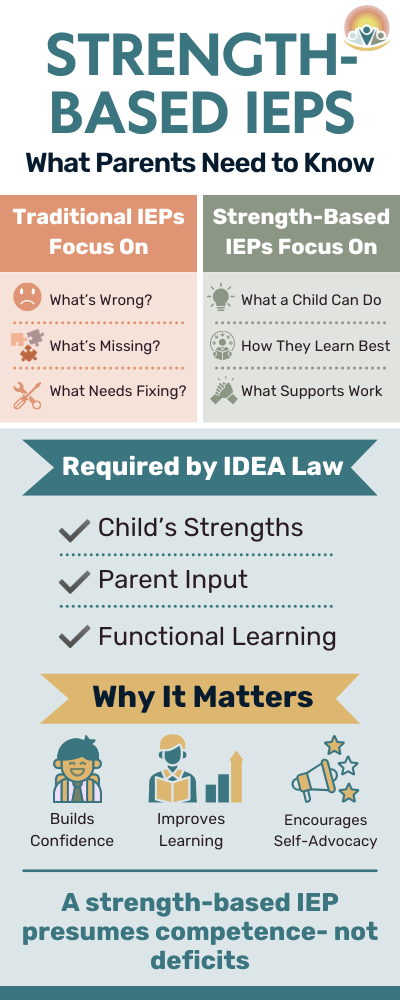
 A strength-based IEP is an Individualized Education Plan that focuses on what your child can do, how they learn best, and what helps them succeed. It captures areas where your child needs help, but doesn’t selectively target what’s “wrong.”
Instead, your IEP team asks important questions like:
- What does my child know?
- What do they need to learn differently?
- How will they demonstrate mastery?
- What supports will help them access the general curriculum?
If you’re new to special education, you'll want to understand how IEPs work to learn what to ask for and how to get it.
A strength-based IEP uses clear and real-world language. It avoids subjective words and focuses on what objective measurable terms describe “what it looks like”. This helps your team know how to teach and, with what support, deliver real-world instruction that actually works!
Do Strength-Based IEPs Ignore Struggles?
No. This is a common myth.
A strength-based IEP looks at ALL your child’s needs. It includes goals, services, and support. The difference is how those needs are described and addressed.
Instead of saying, “Your child can’t…” a strength-based IEP explains:
- What your child knows
- Doesn’t know
- How support is taught differently
This makes the IEP work for your child based on their unique learning needs. Special education is a service, and you and your child are the consumers.
Are Strength-Based IEPs Required by Law?
Yes!
IDEA Law says IEP teams must consider:
- A child’s strengths
- Parent concerns and input
- Functional academics and daily living
Knowing your parent rights under IDEA Law will help you ask for changes if your child’s strengths are missing from the IEP or not being used to guide learning.
Many IEPs still focus mostly on deficits. A strength-based IEP ensures strengths are not just listed once but embedded throughout the IEP to guide goals and instructional support.
How Long Have Strength-Based IEPs Been Around?
Strength-based learning isn't new.
For many years, teachers and researchers have known that children learn BETTER when adults focus on what they can do. In 2004, special education law was updated to explicitly state that students' strengths must be considered in IEPs.
In recent years, more schools have started to talk about learning differences and neurodiverse-affirming practices in a positive way. This has increased awareness of strength-based IEPs, even though not all schools use them or are mandated to implement them.

Why Strength-Based IEPs Matter for Students
Helping Children Feel Confident
When children hear adults talk about their strengths, they feel better. They begin to understand that learning is a process and how to have a flexible mindset.
Strength-based IEPs help students:
- Identify their unique learning needs
- Evaluate service and support effectiveness
- Initiate opportunities for self-advocacy
This is especially important for children and teens who feel uncomfortable or self-conscious about special education.
Watch: Strength-Based IEPs Explained
See real-world examples of WHAT to do and HOW to get strength-based language in your child’s IEP.
Discover 5 secrets that schools don’t tell you.
Why Strength-Based IEPs Help Kids Learn
Strength-based IEPs work because they build on what already helps your child learn.
When strengths are identified by IEP teams:
- Present levels document the right needs
- Accommodations connect with goals
- Services and placement support learning
Instead of asking, “What’s wrong?” Teams ask, “What supports do they need, and how can we implement the IEP with fidelity?”
Learning how to prepare for an IEP meeting helps parents guide conversations to develop and enhance IEPs.
 What Parents Can Say in IEP Meetings
IEP meetings move FAST, and it’s easy to feel unsure about what to say. This guide helps you choose the appropriate strength-based script based on what’s happening in your meeting. Say this to get your child’s IEP back on track.
When IEPs Start with Deficits
Say this: “Before we talk about what my child can’t do, let’s talk about their strengths.”
Why it helps: IDEA requires teams to consider a child’s strengths. Starting with strengths sets a positive tone and helps your team capture all your child’s unique learning needs.
When Present Levels are Negative
Say this: “The present levels are unclear. Let’s change ____ to spell out what it looks like to measure my child’s IEP.”
Why it helps: Present levels are the blueprint that drives IEP development. When strengths are missing, goals aren’t measurable or meaningful.
When Strengths Aren’t in the IEP
Say this: “Their IEP is missing strengths. Where should we add it into the present levels, goals, and accommodations to measure progress?”
Why it helps: Presuming competence changes how teams write IEPs and guides instructional appropriateness.
When Goals Only Focus on Deficits
Say this: “This only states what my child can’t do. Let’s rewrite the goal to spell out what my child knows (functional baselines) and how you’ll teach them differently.”
Why it helps: Strength-based SMARTER goals are meaningful, relevant, and useful for IEP development.
When Inclusion is Unclear
Say this: “Where is it written in the IEP how and when my child will be included with typical peers? Let’s clarify it on the IEP so I can meaningfully participate.”
Why it helps: IDEA Law requires teams to document how students will learn alongside non-disabled peers and why.
When Accommodations Aren’t Specific
Say this: “What strengths were identified in my child’s present levels? Let’s specify which accommodations have been effective and those we should change.”
Why it helps: Accommodations are needs-based and must be selected based on student strengths, preferences, and assessment findings, not your child’s eligibility or placement.

Final Thoughts for Parents
A strength-based IEP doesn’t ignore challenges. It presumes your child is competent and enhances measurable data. When strengths come first, students feel better, parents feel confident, and IEP teams collaborate more effectively.
If your child’s IEP feels negative, it is okay to ask for a strength-based approach. You’re not asking for something extra- you’re asking for what your child needs to succeed.
Ready to Build a Strength-Based IEP? We’re Here to Help.
Advocating for a strength-based IEP can transform your child’s special education experience from focusing on what’s “wrong” to discovering what’s possible. You don’t have to navigate this alone!
At Rise Educational Advocacy®, we empower families with expert advocacy support, DIY IEP workshops, advocacy services, and IEP and 504 Templates designed for every level of experience. Whether you’re preparing for your first IEP meeting or want to rewrite your current IEP with a strengths-forward approach, we provide clear, step-by-step support.
Empower your voice, clarify your next steps, and build an IEP that reflects your child’s unique gifts and needs. Together, we can Build a Better IEP® - one that supports real growth, confidence, and success.
April Rehrig, BCEA, LEP, PPS, CASDCS, is the owner and founder of Rise Educational Advocacy and Consulting, LLC.