

The 6 Pillars of IDEA Law: What Every Parent Must Know About IEP Rights
If your child has an IEP or you think they need one, IDEA protects them.
But many parents are never taught what IDEA actually says. Schools tell you there’s an “IEP Process”, but don’t explain what it looks like.
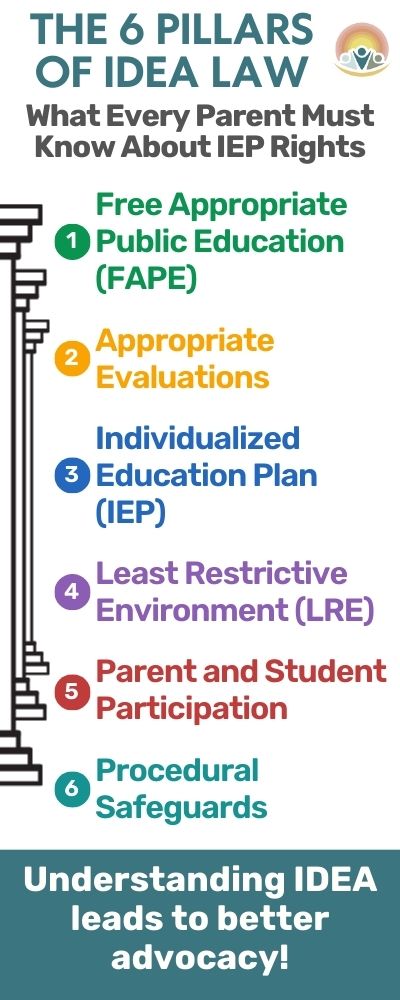
Here’s what you need to know. IDEA stands for the Individuals with Disabilities Education Act. It’s a federal law ensuring students with disabilities receive special education and related services in public schools. Inside IDEA are six core pillars that guide how your school must evaluate your child, write IEPs, provide services, and work with you as parents.
When you understand the six pillars, advocacy becomes easier and more effective. Stop relying on “this is how we do it.” Start using the law to help your child!
Below is a parent-friendly breakdown of the 6 Pillars of IDEA Law, with clear explanations, actionable steps, and parent scripts to use at your next IEP.
Check out this video that walks you through the 6 Pillars of IDEA Law, explaining what it means to understand your special education rights.
Pillar 1: Free Appropriate Public Education (FAPE)
FAPE means your child has the right to a free education that is appropriate for their needs. “Free” means no cost to you. “Appropriate” means the program must help your child make meaningful progress, not just pass tests or matriculate to the next grade.
FAPE includes special education, specially designed instruction, and related services, such as speech therapy, occupational therapy, school-based counseling, behavior intervention plans, and parent training. If your child is not making progress- even if grades look “okay”- your school may NOT be meeting their FAPE obligation.
Your Next Steps:
Ask your school HOW progress is measured to confirm you’re receiving regular IEP progress reports throughout the school year.
Say This:
“Show me the data documenting my child met/didn’t meet their IEP goals. What changes are needed in their IEP to ensure FAPE is being provided?”
Pillar 2: Appropriate Evaluations
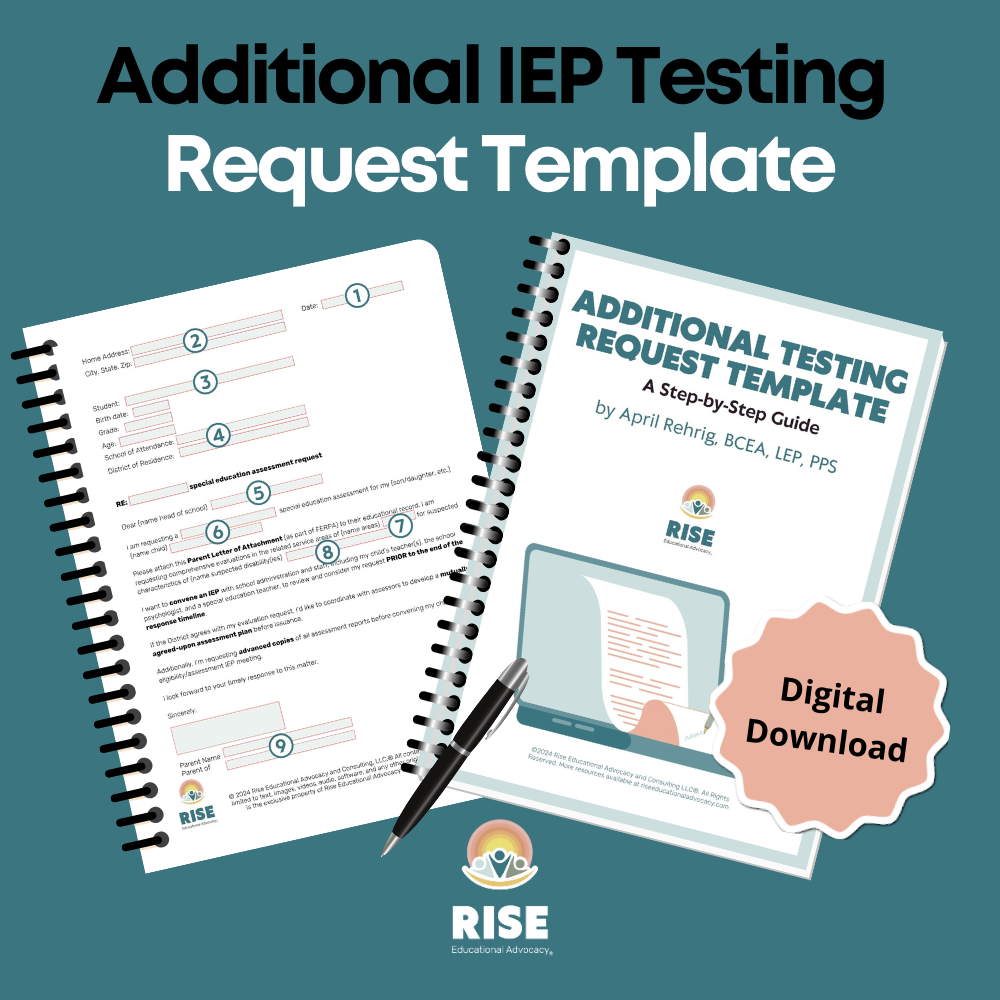 IDEA requires schools to conduct sufficiently comprehensive evaluations before determining eligibility or services by your IEP team. Evaluations must assess all areas of suspected disability, use multiple tools, and avoid relying on a single standardized test or score.
Inappropriate and incomplete evaluations often result in missed IEP services, weak goals, or denying your child support. When you disagree with your school’s evaluation, IDEA gives you the right to request an Independent Educational Evaluation (IEE) at public expense. Our blog, 👉Demystifying IEE Evaluations, explains how and when to request an IEE and before you agree to your child’s IEP assessment.
Your Next Steps:
Submit a letter, also known as a Parent Letter of Attachment, indicating you want additional special education testing or disagree with your child’s special education assessment(s). In some states, this is called an Evaluation Team Report (ETR).
Say This:
“I disagree with the district’s evaluation, as it did not assess all areas of suspected disability for my child. I am requesting an Independent Educational Evaluation under IDEA.”
Pillar 3: Individual Education Plan (IEP)
An IEP is the legal plan that explains how your child will be educated. It must be individualized by your IEP team and based on your child’s specific needs- not staffing, schedules, or budget.
Individual Education Plans must include present levels of academic achievement and functional performance, measurable IEP goals, special education services, accommodations or modifications, and progress monitoring. If it’s not written in the IEP, it may not happen.
IEPs are flexible documents, and your team MUST convene a new IEP meeting to revise the IEP if your child is not making progress. Under IDEA Law, IEPs are not seasonal. This means special education services cannot be delayed or paused because it’s mid-year, summer is coming, or your school wants to “wait and see”. Our blog 👉IEPs Aren’t Seasonal explains why your school must respond in writing to any and all special education requests.
Your Next Steps:
Request an IEP meeting in writing at anytime. This means you can ask for a new IEP if you have concerns, want your team to consider new information, initiate new special education assessments, or modify and change IEP placement or services.
Say This:
“My child isn't making sufficient progress, and the IEP no longer meets their needs. Please schedule a new IEP meeting so we can adjust my child’s services and supports.”
Pillar 4: Least Restrictive Environment (LRE)
IDEA requires students with disabilities to be educated with non-disabled peers “to the maximum extent appropriate” in light of the child’s unique circumstances. This is called the Least Restrictive Environment (LRE) principle.
Schools must first consider supports in general education before moving your child to a more restrictive setting. Placement decisions must be based on data- not convenience, staffing, or funding.
LRE does NOT mean one setting works for every child. It DOES mean choosing the placement where your child can make progress with the right supports.
Your Next Steps:
A more restrictive setting isn’t the first step when your child is struggling. Request a new meeting focusing on adding or changing supports and accommodations, NOT placement.
Say This:
“Before we discuss changing placement to a more restrictive setting, let’s first change my child's supplementary aides and services. What adjustments or modifications to their accommodations do you recommend? Let’s write additional goals to address my child’s newfound needs.”
Pillar 5: Parent and Student Participation
IDEA mandates that parents are equal members of the IEP team. You are not just an observer. Your input matters and MUST be considered.
Parents have the right to attend meetings, review records, ask questions, provide written input, and meaningfully participate in decisions. As students get older, IDEA encourages student involvement, especially for transition planning. Parents have the right to invite individuals with knowledge or expertise regarding their child. You do not have to wait until the mandated age to invite your child to participate in the IEP meeting. Discover more in our 👉Parent Participation workshop.
Your Next Steps:
Submit a written Parent Letter of Attachment and Parent Report before every IEP. Request that this information be added directly into the “Parent Input” section and present level portions of the IEP document.
Say This:
“I’ve attached a Parent Report to the Meeting Notice for team consideration. I’m bringing copies to the IEP meeting, so the team can document my suggested requests and discuss them during the IEP.”
 Pillar 6: Procedural Safeguards
Procedural safeguards are the legal protections that help parents resolve disagreements with schools. These include Prior Written Notice, access to records, mediation, and dispute options.
Safeguards exist to ensure accountability. Using them does not mean you are being difficult- it means you are protecting your child’s rights.
Your Next Steps:
If your school says “no” during an IEP meeting, ask for a formal written explanation. When schools cite a “policy” denying a parent request, ask for a copy. Schools are legally required to provide 👉Prior Written Notice when proposing or refusing to change a child’s IEP identification, evaluation, or placement decision.
Say This:
“I understand you’re saying 'no' to my request. Please put your response in writing through “Prior Written Notice” and provide a copy of my procedural safeguards.”
 Why the 6 Pillars Work Together
The six pillars of IDEA Law are connected. A weak evaluation leads to a weak IEP. A weak IEP limits access to FAPE. A lack of parent participation allows problems to persist.
When you understand IDEA, advocacy becomes grounded in law, data, and documentation, not emotion or guesswork. This leads to stronger outcomes for your child and BETTER progress.
Final Takeaway for Parents
IDEA was created to protect students with disabilities and ensure your child isn’t left behind. The law gives you powerful tools—but only if you know how to use them.
When you understand the 6 Pillars of IDEA Law, you can advocate with clarity and confidence. Knowledge doesn’t create conflict. It creates progress and change.
Ready to Advocate? We’re Here to Help.
Understanding IDEA Law gives you power, but you don’t have to figure it out alone.
At Rise Educational Advocacy®, we help parents use IDEA’s protections to secure appropriate evaluations, strong IEPs, and meaningful progress for their child. Through expert advocacy, parent coaching, DIY IEP workshops, and practical guides, we turn special education law into clear next steps.
Know your rights, use the law, and advocate with confidence. Together, we can Build a Better IEP®, one grounded in IDEA, data, and your child’s true needs. Get started today.
April Rehrig, BCEA, LEP, PPS, CASDCS, is the owner and founder of Rise Educational Advocacy and Consulting, LLC.