
First IEP Meeting for Parents: 7 Tips to Prepare With Confidence
Your first IEP is overwhelming...
Hearing new IEP acronyms, meeting teachers you never knew existed, and wondering, 'What is an IEP?’ You're fearful of saying the wrong thing and desperately want to understand the IEP process.
Take a deep breath.
You don’t need to know everything before your first IEP. However, you must know the basics of IDEA Law, how to prepare for IEP meetings, and speak up so you can meaningfully participate in your first IEP.
An IEP is not just a school meeting. It is a team meeting, where you, as a caregiver, are an essential part of developing the education plan.
In this blog, I’ll walk you through 7 simple tips to help you prepare for your child’s first IEP meeting to advocate like a pro.
Watch the Video: First IEP Meeting for Parents
Before your IEP, watch this video on first IEP meeting tips for parents to know what to expect and how to prepare.
What Is an IEP Meeting?
An IEP meeting is when your school discusses your child’s strengths, challenges, possible eligibility for special education and/or related services, and how the school will remediate your child’s learning needs.
IEP stands for Individual Education Plan (sometimes known as Program). Under IDEA Law, an IEP must be designed to meet your child’s unique needs to receive a Free Appropriate Public Education (FAPE) in the Least Restrictive Environment (LRE).
What does FAPE mean?
FAPE means your child has the right to access special education and related services at no cost to parents. Their education must meet their needs to prepare them for further education, employment, and independent living.
What does LRE mean?
LRE means your child is educated with their non-disabled peers to the maximum extent possible, given their unique circumstances. LRE isn’t a place- it’s a process that your IEP team must explain if and why your child is being placed outside a general education class.
That is why preparation matters. Your first IEP meeting is not just about qualifying for an IEP. It is about crafting the right plan for your child. To build a strong foundation, you can explore the 6 Pillars of IDEA law to better understand your child's legal protections.
Tip 1: Read Everything Before the Meeting
One of the best IEP meeting tips for parents is this: don’t walk in unprepared.
Before the meeting, ask for copies of any documents your team plans to review.
When you read documents ahead of time, you have time to think clearly. Document your concerns and ask questions.
Say this
“Please send me the draft reports and/or IEP documents before the meeting so I can access my child’s record and meaningfully participate in the upcoming meeting.”
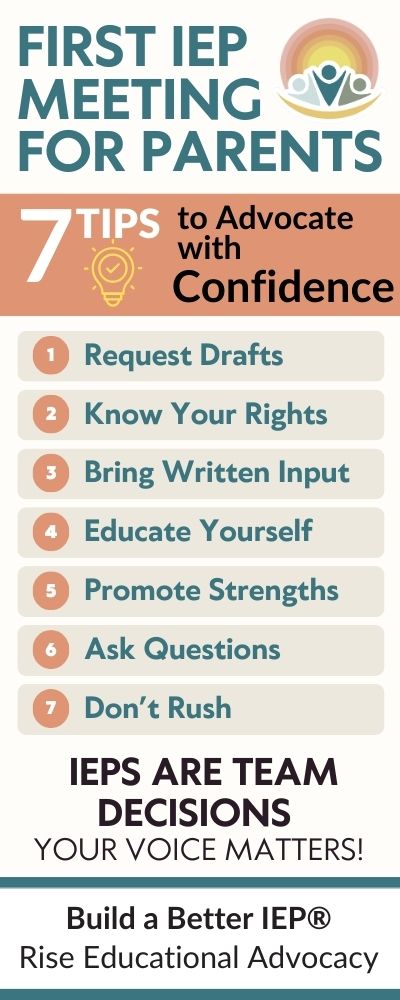
Tip 2: Know Your IEP Parent Rights Under IDEA Law
Parents have legal rights in the IEP process.
Under IDEA Law, parents have the right to participate in meetings, share concerns, review records, ask questions, and receive procedural safeguards.
- The Right to Informed Consent (Parental Consent)
- The Right to Participate in Decision-Making
- The Right to Inspect & Review Records
- The Right to Request Evaluations & Independent Educational Evaluation (IEE)
- The Right to Prior Written Notice (PWN)
- The Right to “Stay Put”
- The Right to Confidentiality
- The Right to Dispute Resolution

What are procedural safeguards?
Procedural safeguards are the legal protections that explain your rights in special education. They help families understand what to do if they disagree with the school, resolve disputes, and get notice of their rights under IDEA Law.
These rights matter because parent participation is an essential part of the IEP process.
Tip 3: Bring a Parent Report and Parent Letter of Attachment
If you want to meaningfully participate in the IEP process, put your concerns in writing.
A Parent Report is your summary documenting present levels of performance, your child’s strengths, concerns, and what support your child needs.
A Parent Letter of Attachment (PLA) is a written statement attached to your child’s educational record, IEP, and/or special education assessment documenting your parent input, request(s), and/or disagreement.
Why this helps
Meetings move fast. Parents can get interrupted. Conference IEP/team meeting notes may not accurately document your input. An attached written statement creates a clear record of your concerns and participation.
Say this
“Please attach this Parent Letter of Attachment to my child’s IEP, so my concerns are documented.”
This is one of the best ways to strengthen parent input, request changes, and document your child’s needs.
 Tip 4: Learn the Main Parts of an IEP
You don’t need to be a special education advocate, but it helps to know the basic parts of an IEP before your first meeting.
Present Levels of Performance
Present levels describe how your child is doing and what it looks like. They should include what your child can do (strengths), can’t do (weaknesses), needs to learn (goals/programming changes), and barriers that impact learning.
Annual Goals
IEP goals should be clear and measurable. You should be informed of what skill is being taught and how progress will be monitored.
Services
IEP services describe what type of support your child will receive, when service(s) will start and end, and intensity and/or instructional methodology.
Accommodations and/or Modifications
Supplementary aides and services describe HOW your child will access learning and/or WHAT curricular or instructional changes are needed, if appropriate. It is essential for parents to understand the difference between IEP accommodations and modifications to ensure the right level of support is provided.
Placement
Placement is where your child will be educated based on need and must support access to the curriculum in the Least Restrictive Environment.
Tip 5: Talk About Strengths, Not Just Deficits
Your child is more than their eligibility and/or disability. Language MATTERS in their IEP.
At your first IEP meeting, it is easy for conversations to focus only on deficits or test scores. But a strong IEP must capture both your child’s strengths and needs.However, a robust plan must capture your child’s unique abilities. You can read more about creating strength-based IEPs to ensure your child's talents are documented alongside their needs.
Say this
“I want to make sure my child’s strengths are clearly documented throughout the IEP, not just listed at the top.”
 Tip 6: Ask Questions Until Plans Make Sense
Parents don’t need to stay quiet to be cooperative.
You’re allowed to ask questions.
You’re allowed to ask for an explanation.
Simple IEP advocacy questions
- “Can you document what this looks like in the IEP?”
- “Can you explain what this means and how it impacts my child?”
- “Can you show me where it’s written in the IEP?”
- “Can you put that in writing?”
IEP advocacy isn’t about being difficult. It is about protecting your child’s rights.
Tip 7: You Don’t Have to Decide Everything on the Spot
This is one of the most important first IEP meeting tips for parents.
You don’t have to rush.
If you need time to review the IEP and consider recommendations, it’s okay to ask.
Say this
“Thank you. I’d like time to review and consider this before making a decision.”
The goal isn’t to finish IEPs. It’s to build the most appropriate plan in light of your child’s unique learning needs.
Final Thoughts for Parents
Your first IEP meeting doesn’t need to be perfect.
You may not know every answer, so take one step at a time.
When you understand the basics of IDEA Law, parent rights, procedural safeguards, Free Appropriate Public Education, and Least Restrictive Environment, you’re in a stronger position to advocate for your child.
IEP meetings are NOT “school decisions”. They’re team decisions, and your voice matters!
Ready to Build a Better IEP?
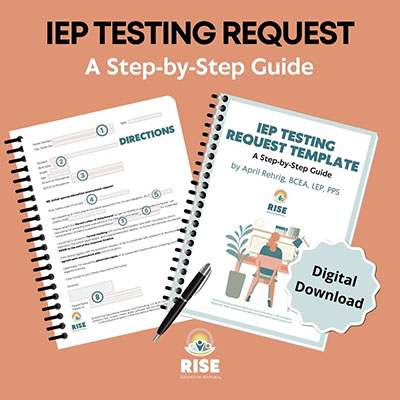
At Rise Educational Advocacy®, we help parents navigate their first IEP meeting by securing the comprehensive IEP testing needed to kickstart the special education process. Through my expert advocacy, parent IEP coaching, IEP workshops, and practical guides, I show you how to turn an overwhelming IEP meeting for parents into a strength-based education plan.
My goal is to help you understand your IEP parent rights, navigate procedural safeguards, and advocate with confidence. Together, we can Build a Better IEP® based on meaningful data from the start.
Click 👉HERE to book a parent consultation.
April Rehrig, BCEA, LEP, PPS, CASDCS, is the owner and founder of Rise Educational Advocacy and Consulting, LLC.