

IEP Parent Rights Explained: Procedural Safeguards You Must Know
If your child has an IEP, or you think they may need one, understanding your IEP parent rights can change the way you walk into a special education meeting.
Parents are not just invited guests at the IEP table.
Under the Individuals with Disabilities Education Act (IDEA), parents have important rights throughout the special education process. These rights are called procedural safeguards.
Procedural safeguards help protect your child’s right to a Free Appropriate Public Education (FAPE). They also give you ways to participate, review records, give or withhold consent, disagree with decisions, and resolve problems.
The paperwork can feel overwhelming. But you do not need to memorize special education law. You need to know your most important rights, and where to find them when you need them.
Watch: IEP Parent Rights Explained
This video explains every IEP safeguard so you can protect your child’s education and get the best IEP to help your child.
What Are Procedural Safeguards in Special Education?
Procedural safeguards are the legal protections IDEA gives parents and students during the special education process.
They cover important areas such as parent participation, consent, education records, Prior Written Notice, Independent Educational Evaluations, dispute resolution, discipline, and other special education parent rights.
Think of your procedural safeguards as a roadmap.
You may not need every protection today. But when you have a question, disagree with the school, or are unsure about your next step, your safeguards can help you understand your options.
When Must a School Give Parents Procedural Safeguards?
Under federal IDEA rules, schools must provide parents with a copy of their procedural safeguards at least once each school year.
Parents must also receive them when they first request an evaluation or their child is initially referred for evaluation, after the first state complaint or first due process complaint during the school year, in certain discipline situations involving a change of placement, and whenever a parent asks for a copy.
You do not have to wait for your school to offer them. Ask for the most current copy.
The notice must also be written so parents can understand it and provided in the parent’s native language or other mode of communication unless doing so is clearly not feasible.
IEP Parent Right #1: Participate in IEP Meetings
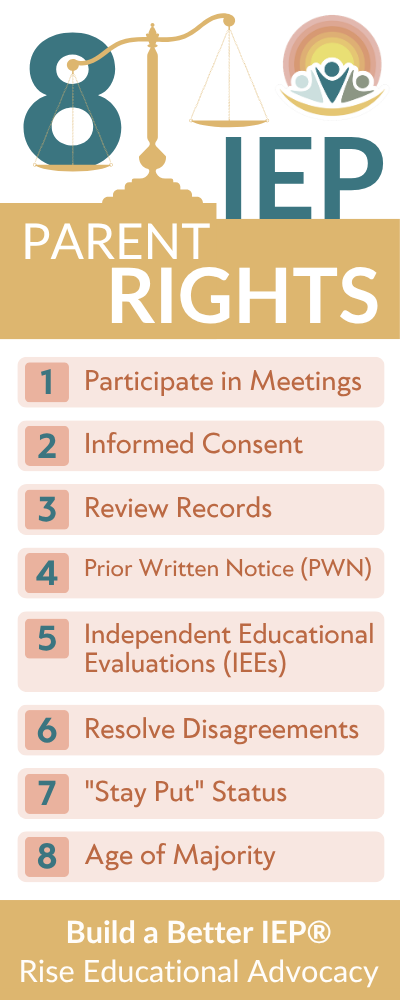 Parents are members of the IEP team.
Your school must take steps to make sure you have the opportunity to participate. This includes notifying you early enough to attend and scheduling the meeting at a mutually agreed time and place.
Your input matters.
Share your child’s strengths, needs, concerns, progress, and what you see outside of school.
And if you do not understand an acronym, test score, goal, placement, accommodation, or service, ask the team to explain it in plain language.
You have a right to understand the decisions being discussed about your child.
IEP Parent Right #2: Give Informed Consent
Parental consent is another important special education right.
Under IDEA, the school generally needs your informed consent before conducting your child’s initial special education evaluation and before providing special education services for the first time. Consent is also generally required before a reevaluation, although certain exceptions apply if a parent does not respond after the school makes reasonable efforts.
Federal IDEA rules do not require parent consent for every IEP change in every state. States may have additional consent requirements.
Before signing anything, slow down and make sure you understand exactly what you are agreeing to.
IEP Parent Right #3: Review Your Child’s Education Records
Parents have the right to inspect and review their child’s education records.
Under IDEA, the school must respond to a records request without unnecessary delay and, when applicable, before an IEP meeting or certain proceedings, and no later than 45 days after the request. Parents can also ask for explanations or interpretations of those IEP records.
There is one important distinction.
Federal law gives you access to existing education records. It does not automatically require every district to create or provide draft IEP documents before an IEP meeting.
Some states or districts provide stronger access to drafts, and parents can certainly ask for them.
IEP Parent Right #4: Receive Prior Written Notice
 Prior Written Notice, often called PWN, is one of the most important IEP parent rights to understand.
A school must provide written notice a reasonable time before it proposes or refuses to start or change your child’s identification, evaluation, educational placement, or provision of FAPE.
Prior Written Notice should explain what the school proposed or refused, why it made the decision, what information it relied on, what other options were considered and rejected, and other factors related to the decision.
So, if you request an important evaluation, service, support, or placement change and the district says no, ask:
“Will you document the district’s refusal in Prior Written Notice?”
That creates a written record of the school’s decision and reasoning.
IEP Parent Right #5: Request an Independent Educational Evaluation
What happens if you disagree with an evaluation completed by your school district?
IDEA gives parents the right to request an Independent Educational Evaluation (IEE) at public expense when they disagree with an evaluation obtained by the public agency.
Once a parent requests an IEE at public expense, the district must, without unnecessary delay, either provide the IEE at public expense or file for due process to show that its evaluation was appropriate.
The school may ask why you disagree, but it cannot require you to explain your reason before responding to the request.
Parents are generally entitled to one publicly funded IEE each time the district conducts an evaluation they disagree with.
IEP Parent Right #6: Resolve Special Education Disagreements
 What if you and the school cannot agree?
You still have options.
Depending on the problem, parents may ask to reconvene the IEP team, request an evaluation or reevaluation, participate in mediation, file a state complaint, or file a due process complaint.
These options are not all the same. They serve different purposes and follow different procedures and timelines.
Your procedural safeguards should explain state complaints, due process complaints, mediation, hearings, and other dispute resolution protections available under IDEA.
Understanding those differences can help you decide what step fits your concern.
IEP Parent Right #7: Understand “Stay Put”
You may have heard the term “stay put” during an IEP disagreement.
“ Stay put" in an IEP is often misunderstood.
Under federal IDEA rules, stay put generally means that while a due process case or related administrative or court proceeding is pending, the child remains in their current educational placement unless the parent and school agree otherwise. Special exceptions can apply, including certain discipline situations.
Simply telling the district in writing that you disagree with an IEP does not necessarily trigger federal stay put.
That distinction is important when placement or services are in dispute.
IEP Parent Right #8: Prepare for Rights to Transfer at Age 18
Your child’s special education rights may change when they become an adult.
In states where IDEA rights transfer at the age of majority, often age 18, many of the rights that previously belonged to the parent transfer to the student.
When state law provides for this transfer, the school must notify both the student and the parents. Special procedures may also apply to some students who cannot provide informed consent.
That is why transition planning should include more than college, employment, and independent living. Families should also understand who will make educational decisions once the student becomes a legal adult.
Know Your IEP Parent Rights Before You Need Them
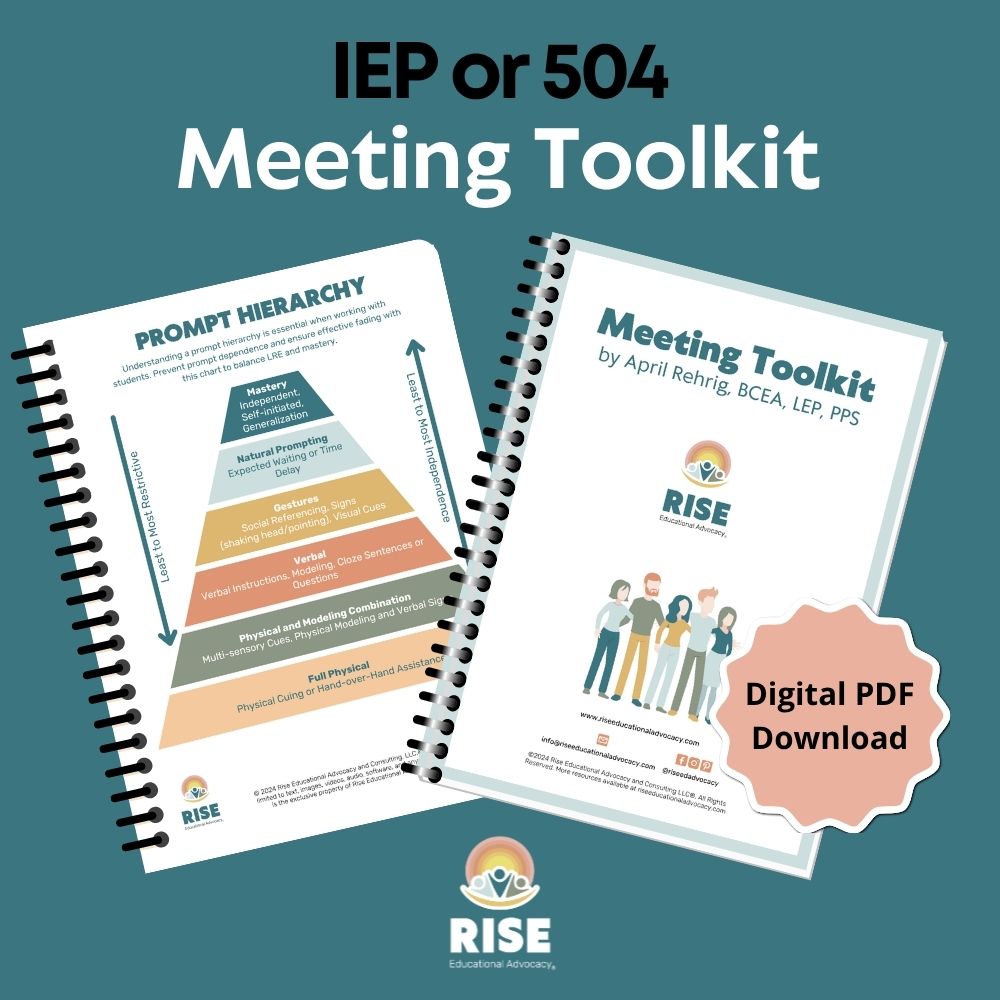 You do not need to become a special education attorney to be a strong advocate for your child.
Start by knowing where your procedural safeguards are.
Read the section that applies to the problem in front of you. Ask questions. Keep important requests in writing. And when the school proposes or refuses something important, make sure you understand what was decided, why it was decided, and what you can do next.
The goal is not conflict.
The goal is meaningful parent participation and an IEP that meets your child’s unique needs.
When parents understand their IEP rights, they can come to the table with better questions, clearer expectations, and more confidence to help Build a Better IEP™.
Frequently Asked Questions About IEP Parent Rights
What are procedural safeguards in an IEP?
Procedural safeguards are legal protections under IDEA for parents and students receiving special education services.
They cover rights involving evaluations, parental consent, school records, IEP participation, Prior Written Notice, IEEs, mediation, complaints, due process, discipline, and more.
How often should parents receive procedural safeguards?
Under federal IDEA rules, parents must receive the procedural safeguards notice at least once each school year. Schools must also provide it at several other important times and whenever a parent requests a copy.
Can a parent refuse to sign an IEP?
It depends on what you are being asked to sign and your state's laws.
IDEA requires informed parental consent for an initial evaluation and before special education services begin for the first time. States may require parental consent in additional situations.
Can parents see school records before an IEP meeting?
Yes.
When parents request education records, IDEA requires access without unnecessary delay and, when applicable, before an IEP meeting. In all cases, IDEA sets an outside federal limit of 45 days.
What is Prior Written Notice in special education?
Prior Written Notice is a school district’s written explanation when it proposes or refuses certain actions involving a student’s identification, evaluation, educational placement, or FAPE.
It must explain the action and why the school made that decision.
Can parents request an Independent Educational Evaluation?
Yes.
If you disagree with an evaluation your school district obtained, IDEA gives you the right to request an Independent Educational Evaluation (IEE) at public expense, subject to IDEA’s requirements.
Does stay put start as soon as a parent disagrees with an IEP?
Not necessarily.
Under federal IDEA rules, stay put generally applies during the pendency of a due process complaint and related administrative or court proceedings unless the parties agree otherwise or an exception applies.
Ready to Build a Better IEP?
If your child has an IEP or you're trying to understand your child’s special education rights, Rise Educational Advocacy® helps you ask the right questions, understand the IEP process, and build stronger support for your child.
Through our expert advocacy, parent IEP advocacy, IEP online workshops, and practical special education guides, we show you how to turn an overwhelming IEP into a strengths-based plan.
Your child deserves an IEP that supports them and helps them make meaningful progress.
Get started today with a parent consultation.
April Rehrig, BCEA, LEP, PPS, CASDCS, is the owner and founder of Rise Educational Advocacy and Consulting, LLC. This information is for educational purposes and is not legal advice. Special education laws and procedures can vary by state.